Most people don’t lose money on land because they’re reckless.
They lose money because of one bad phone call.
Because what you say in the first 30 seconds of that conversation…
Determines whether you walk away with clarity… or confusion.
And confusion is expensive.
Why This Call Matters More Than You Think
Before you buy land, there’s one thing that matters more than the listing…
More than the photos…
More than the price…
👉 What the county allows.
Because counties don’t approve ideas.
They enforce code.
- Minimum square footage
- Dwelling types
- Foundation requirements
- Setbacks
- Permitted uses
And if what you want to build doesn’t fit within that code…
Nothing else matters.
Why Most County Calls Go Wrong

Here’s what usually happens.
Someone finds a property they like.
The listing says:
- “No restrictions”
- “Tiny homes allowed”
- “RV living okay”
So they pick up the phone and ask:
👉 “Can I build a tiny home there?”
Sounds reasonable.
But it’s the wrong question.
Because “tiny home” isn’t a zoning classification.
It’s a YouTube word.
Where This Goes Sideways
The county might say:
👉 “No, we don’t allow tiny homes.”
And the buyer walks away thinking:
“I guess I can’t build there.”
But what the county may have meant was:
- No homes under 600 sq ft
- No structures on wheels
- No park model RVs
They may absolutely allow:
👉 A 600–900 sq ft single-family dwelling on a permanent foundation
Same dream.
Different language.
One question killed it.
The Reverse Problem (Even Worse)
Sometimes the county says:
👉 “Yes, single-family dwellings are allowed.”
And the buyer hears:
“I’m good to go.”
But they never asked about:
- Minimum square footage
- Setbacks
- Driveway permits
- Septic feasibility
So they walk away with confidence…
But not clarity.
👉 And confidence without clarity is expensive.
PawPaw Reality Check
The goal of the call is NOT to get a yes.
The goal is to gather specifics.
How to Prepare Before You Call (Most People Skip This)
Before you ever dial the number…
Pause.
Because how you prepare determines how useful that call will be.
Do NOT call like this:
- While driving
- While scrolling your phone
- Without anything written down
That signals:
👉 “I’m casually curious”
And casual calls get casual answers.
Do this instead:
Sit down.
Have something to write with.
Open the listing on a computer.
And have this ready:
1. Parcel Number (Most Important)
This is how counties identify land.
Not the address.
2. Property Address (If Available)
Some land doesn’t even have one yet.
That tells you something.
3. Acreage
Zoning rules can change based on size.
4. Zoning Classification
Example:
- R-1
- A-1
- Residential Agricultural
Write it exactly.
5. Clear Description of Your Plan
Not:
- “tiny home”
- “something small”
Instead:
👉 “A 900-square-foot single-family dwelling on a permanent foundation”
That one shift changes everything.
How to Open the Call (This Sets the Tone)
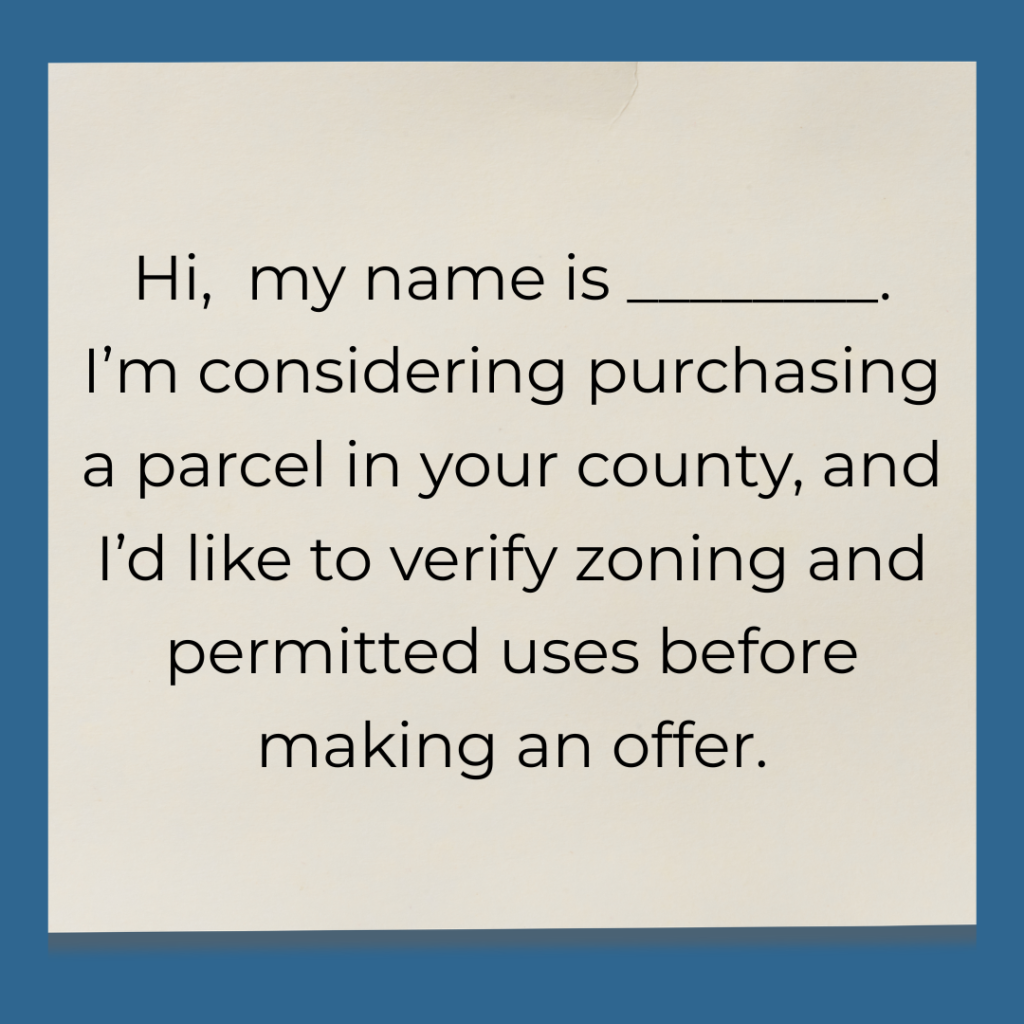
Use this exact structure:
“Hi, I’m considering purchasing a parcel in your county, and I’d like to verify zoning and permitted uses before making an offer.”
This does three things:
- Shows you’re pre-purchase
- Signals due diligence
- Frames the call as verification—not approval
And that changes how they respond to you.
The Right Questions to Ask (In Order)
1. Zoning (The Master Switch)
Ask:
👉 “What is the current zoning classification for this parcel?”
If zoning doesn’t allow your use…
👉 Nothing else matters.
2. Permitted Use
Ask:
👉 “Are single-family dwellings permitted in this zoning?”
If they say “it depends”:
👉 Ask: “What does it depend on?”
3. Minimum Square Footage
Ask:
👉 “What is the minimum square footage requirement?”
Follow up with:
👉 “How is that calculated?”
This is where most people get burned.
4. Setbacks
Ask:
👉 “What are the front, side, and rear setbacks?”
Because you can own land…
And still not be able to build where you want.
5. Accessory Structures
Ask:
👉 “Are there restrictions on accessory structures?”
Follow up:
👉 “Can they be built before the primary dwelling?”
6. Driveway / Access
Ask:
👉 “Are there driveway or access requirements?”
This can include:
- permits
- culverts
- road standards
7. Septic / Utilities
Ask:
👉 “Who should I speak with about septic requirements?”
Because zoning usually doesn’t handle that.
What NOT to Say (This Matters More Than You Think)
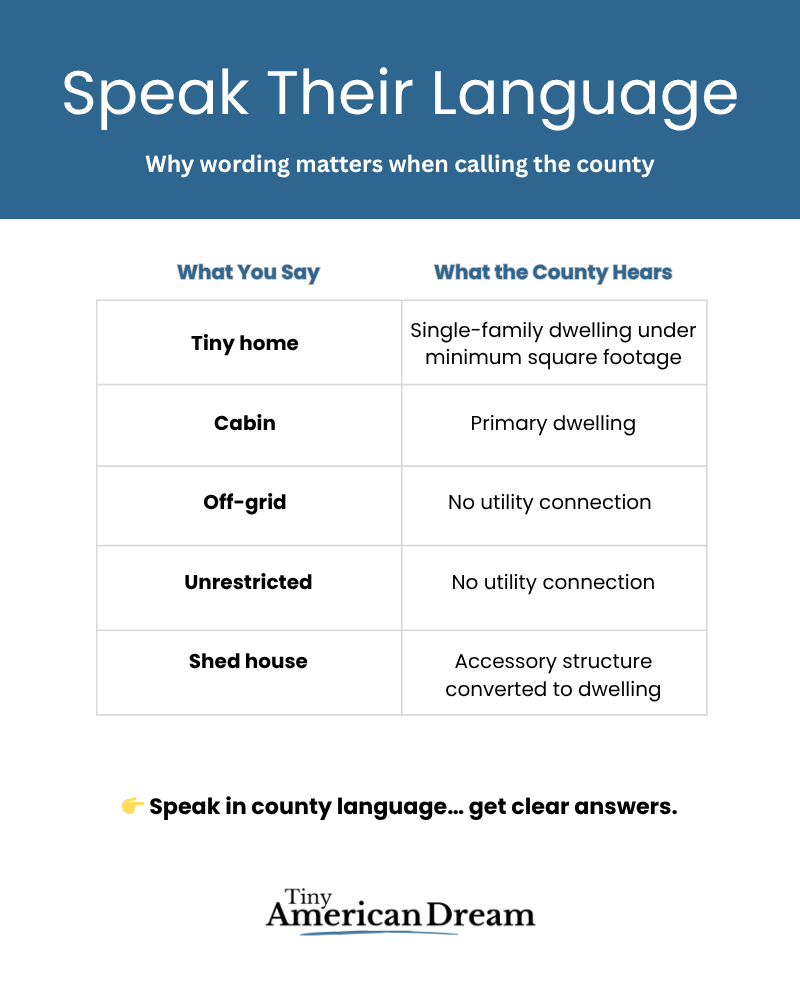
❌ “The real estate agent said it’s unrestricted”
“Unrestricted” is marketing.
Not code.
❌ “My friend built one down the road”
You don’t know their situation.
❌ “Will you approve this?”
You’re not asking for permission.
You’re verifying code.
❌ “It’s just a small cabin”
Vague language creates vague answers.
Here’s a simple way to think about it:
How to Document the Call (This Protects You)

The call doesn’t protect you.
Your notes do.
Write down:
- Name of the person
- Department
- Date and time
Write answers EXACTLY as given
Not your interpretation.
Ask for references:
👉 “Is there a code section I can reference?”
Track open items:
- septic
- driveway
- utilities
Build a checklist.
Why This Must Happen BEFORE You Close
This is the part most people get wrong.
They think:
👉 “I’ll figure it out later.”
But once you close:
- You lose leverage
- You own the problem
- You can’t walk away
Before closing:
- You can negotiate
- You can verify
- You can walk
After closing:
You’re stuck solving
The Right Way to Think About This
Most people:
- dream first
- design first
- plan first
Then run into problems.
Smart buyers:
- verify zoning
- confirm rules
- check feasibility
THEN move forward
Final Thoughts
This call isn’t about bureaucracy.
It’s about protection.
Because once the deed is recorded…
Clarity becomes hindsight.
Before You Buy Land…
If this feels like a lot…
That’s because land requires structure.
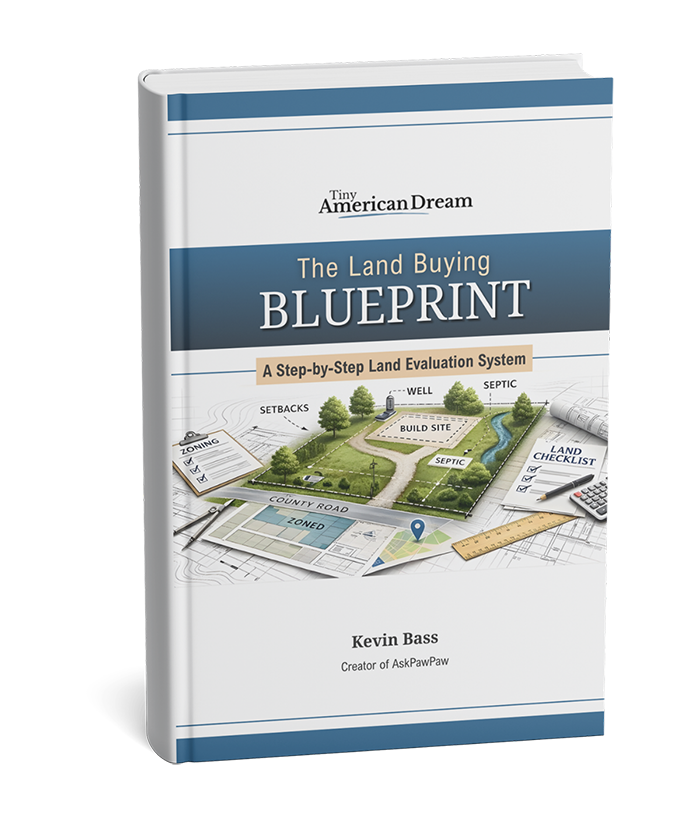
That’s exactly why I built the Land Buying Blueprint.
It walks you through:
- what to verify
- what to ask
- what to document
- what to confirm
before you commit.
Because guessing is expensive… Verification isn’t.
Related Reading
To go deeper, you may also want to read:
- Can You Legally Live in an RV on Your Own Land? (The Truth Most People Miss)
- What “No Restrictions” Really Means (And Why It Can Cost You If You Get It Wrong)
- Septic Basics: What Makes Land Buildable